But let’s not talk about the home-made video genre today. Let’s talk about cinema and its unparalleled influence on us in terms of using certain color patterns. Here is a list of the most iconic ‘color’ moments motion pictures have ever given us!
1. The Wizard of Oz (1939)
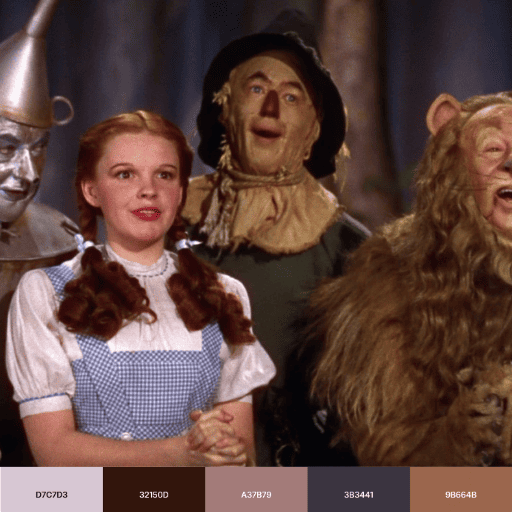
If you haven’t seen this iconic film, you have some damage control to do. So do it quick. If you have, then you’ve most certainly noticed how color was used as a threshold between worlds.
Soft sepia for Kansas. Then full Technicolor Oz transition. I wouldn’t be afraid to call it “color plot twist” that defined cinema at the time.
How did they achieve this? The moment Dorothy opens the door, we KNOW that we’re crossing into a different psychological reality with her, because the color palette tells us so.
Not an enthusiast? Then you’ve probably missed this. The famous ‘ruby slippers’ were not ruby originally. The color was changed from Baum’s original silver. People knew how to flaunt the Technicolor process.
Let’s all hold hands for psychological influence. The intense red taps into high-arousal associations, i.e., alertness, urgency, desire, etc. So, anchoring the shoes as a visual “fixation point” was a ballsy move that paid off.
2. The Red Shoes (1948)
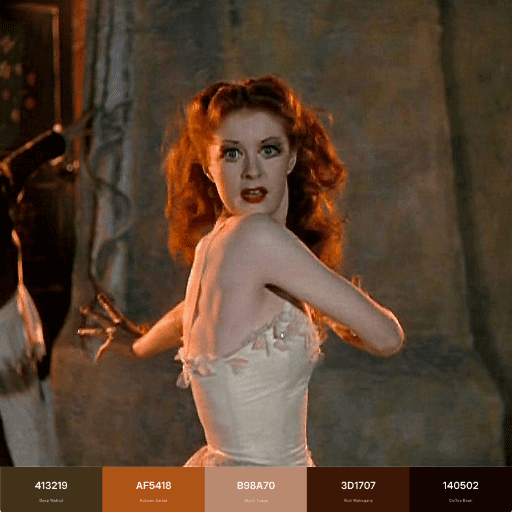
See where I’m going with this? Our first entry on the list solidified the importance of red in early cinema. Can you blame them? Worked like a charm.
Then along came “The Red Shoes”, Emeric Pressburger and Michael Powell’s story of a young ballerina, torn between performance and love.
Critics and historians note that the blazing reds in costumes and sets make the heroine’s conflict between “life” and “art” feel visceral, not abstract.
3. Vertigo (1958)
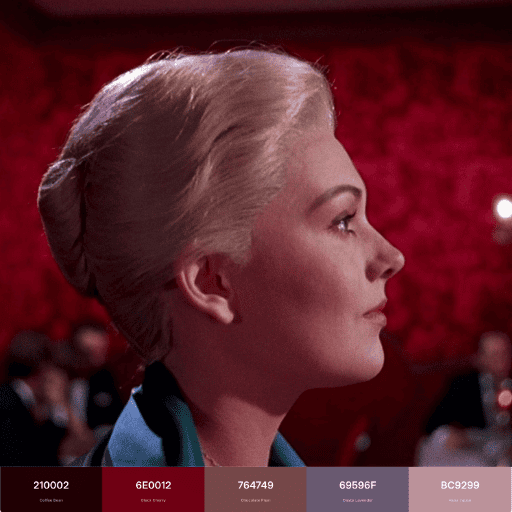
Notice how we’re moving up a decade? By this time color has established a firm place in viewers’ minds, and has a tight grip on cinema chairs. Sir Hitchcock wasn’t knighted for nothing, you know. While he didn’t work with color too often, his Vertigo left viewers speechless.
In this movie he builds a whole language around green and red: Madeleine/Judy is repeatedly framed in eerie greens, often set against complementary reds in the environment.
Red and green are one of the brain’s opponent pairs, so those combinations are inherently high-contrast in our visual system.
Hitchcock is literally “pulling” on a neurophysiological tug-of-war to make Scotty’s obsession feel unstable and wrong.
If you haven’t watched this visual neurosis, why are you still here reading this? Go, go!
Aaand, we’ll move up another decade or two.
4. Pleasanville (1998)
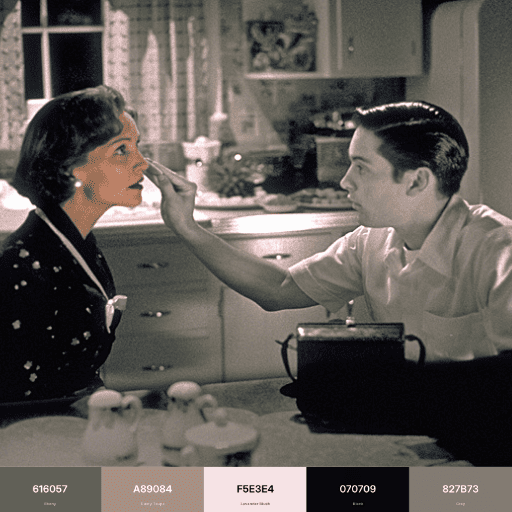
Ok, four decades, but we have to mention this one. At this point, naturally, color doesn’t phase anyone. We’re long used to it, and don’t pee ourselves with delight at the sight of technicolor, or modern digital grading, for that matter. But this film adds a new layer entirely.
We could argue about the originality of the love stories in focus, but Director Gary Ross uses color as an essential tool to get his point across.
The movie starts in black-and-white suburbia. Characters “turn to color” only as they break from repression and discover desire, curiosity, or rebellion.
Because color images are remembered better and feel more vivid than grayscale ones, the film uses the arrival of color to mark moments that should lodge in memory as emotionally significant.
5. Schindler’s List (1993)
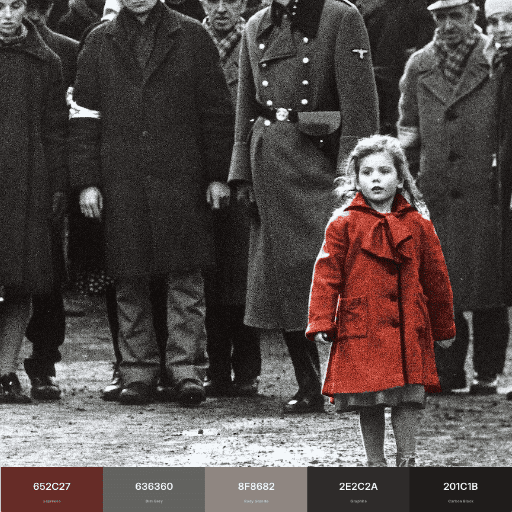
The decade thing didn’t work, but this film deserves all the mentions in the world. Depressing reality-based cinema is not everyone’s cup of tea, but you can’t deny the shift in the western film tradition that this masterpiece stirred.
Spielberg famously shoots the Holocaust in stark black-and-white… except for the girl in the red coat. That single chromatic element becomes a focal point of horror, innocence, and Schindler’s moral awakening. Selective color massively increases salience and emotional punch.
6. The Matrix (1999)
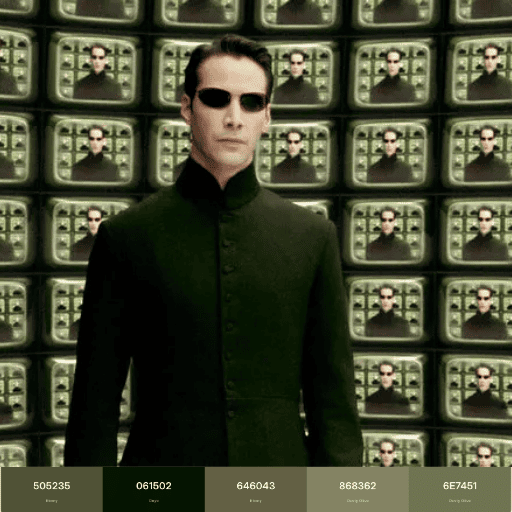
I believe it needs no introduction, and if it does, I will pray for the state of your awareness, or the lack thereof. Inside the Matrix, everything is tinted green, and for a good reason.
The color echoes monochrome computer monitors and suggests a kind of digital sickness or corruption. The “real world” is more neutral and cold, with that green cast removed.
The psychological side is fascinating. The film leans on learned associations, meaning green CRT screens, institutional lighting, etc. Plus, color-constancy expectations. Once you accept that green equals simulation, the tiniest hue shift becomes a subconscious cue about what’s real.
We’re all just Pavlov’s dogs. I rest my case.
7. The Cook, the Thief, His Wife & Her Lover (1989)
A step back in time, I know, but bear with me. Peter Greenaway’s film is a masterclass in color-coded spaces. Every room in the restaurant changes hue, and the characters’ costumes change color with the room. Red dining hall, green kitchen, blue bathroom, white library. Each palette is a psychological state rather than decor.
Greenaway uses color not to symbolize emotion abstractly, but to control the viewer’s emotional temperature on a room-by-room basis.
Research shows that strong hue-context changes disrupt color constancy and activate conflict-processing circuits, the anterior cingulate cortex to be exact. This film weaponizes that effect. When a character’s clothing changes instantly with the surroundings, your brain registers a perceptual “error,” heightening unease.
Academic analyses highlight this film as a rare case where color functions as ‘architecture’ of sorts, dictating relationships and power dynamics more than dialogue does.
Is there a better way to end the list? Probably not. There are tons of wonderful cinema masterpieces out there that utilized the great power of color palettes on our little brains, and we’ve never looked back.