Blue and green light make cyan. With paint, the result is usually a blue-green shade, often described as teal or turquoise. The particular pigments and the amount of each paint determine where it lands.

Light and paint give different results
On an RGB screen, switching the blue and green channels fully on while leaving red off gives cyan, #00FFFF. This is additive mixing: the light from the two channels combines. The Institute of Physics shows the same blue-plus-green result in its colored-light demonstration.
Paint works differently because pigments absorb some wavelengths and reflect others. Two tubes labeled blue and green won’t give one guaranteed HEX code. GOLDEN’s Teal acrylic contains phthalo blue, phthalo green and titanium white. The white is part of that particular formulation, not a requirement for every blue-green mixture.
Trying the mixture with paint
Start with a small amount of each color on a spare surface. You can adjust the mixture without sacrificing half a tube:
- Add a little more blue to move it toward blue-green.
- Add green gradually if you want a greener result; a strong pigment can take over quickly.
- Mix a separate dab with white to see a lighter version.
Keep a little of the original mixture aside before each adjustment. It gives you something to compare against when the next dab looks almost, but not quite, right.
Blue and green color combinations
Mixing the colors together and placing them side by side are different choices. A dark blue beside a yellow-green keeps the two distinct; blending them removes that sharp boundary.
Catalina Blue & Green Yellow
Use the deep blue for the larger area and the brighter green-yellow for smaller details, such as a heading or border. A narrow green-yellow border can be enough.
Madison & Yellow Green
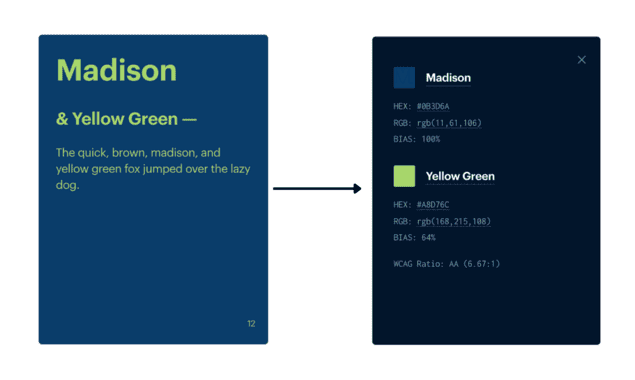
The palette shown here pairs a dark blue with a lighter yellow-green. Our blue and yellow collections offer nearby shades to compare. For text, check the exact foreground and background colors for contrast before settling on the pair.
Green and blue in a room
A blue sofa and green cushions let you try the combination without repainting the walls. For a larger change, put paint samples beside the existing floor and furniture, then look at them in daylight and under the lamps you actually use.
Texture can break up similar colors: matte blue paint, green woven fabric and a pale wood surface won’t read like three flat swatches. Small pink details are another option if the room needs a warmer accent. Furniture placement and lighting also shape the room; these interior design ideas cover the wider arrangement.