
Its color is a dark blue.
And there are 12 yellow stars on it. They do not count EU member countries.
The number 12 represents perfection and completeness, according to the Council of Europe.
Design
The stars sit at equal intervals, like the hours on a clock. Each has five points, with one pointing straight up, as the official graphic standards specify.
The circle stands for unity. The stars represent the ideals of solidarity and harmony among the peoples of Europe.
Rejected flags
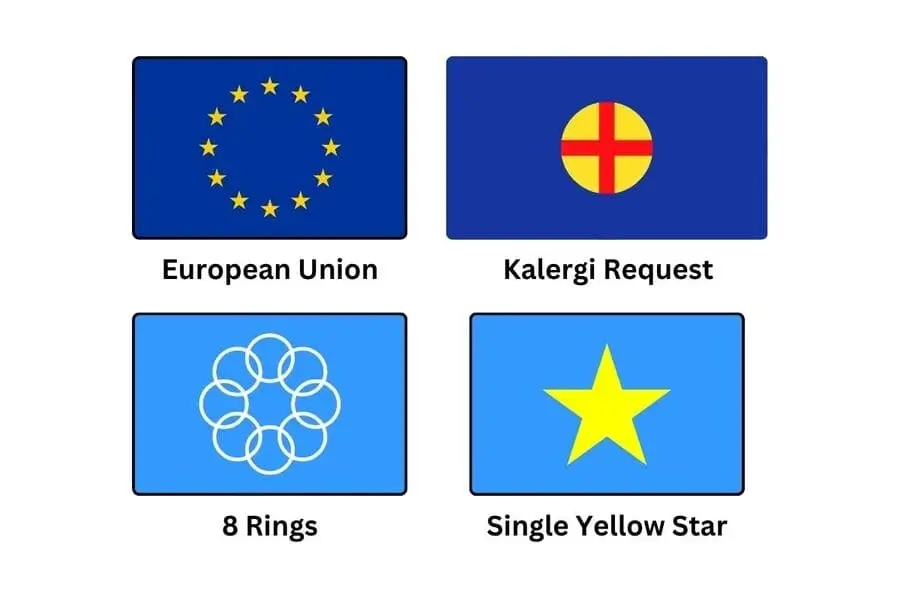
Three of the alternative designs are shown below.
Coudenhove-Kalergi proposal

A red cross inside a yellow circle and a blue background. This was the Pan-European Movement’s flag. The Council of Europe’s archive records British and Turkish objections to using a cross in the European emblem.
8 Rings

The blue of this flag is a much lighter blue than that of the original flag. This flag reminds me of the Olympics at first glance. An eight-ring design was considered in 1954, but it was not adopted.
Single Yellow Star

A single yellow star fills the blue field. Compared with the final circle of twelve, the emphasis is on one large central symbol.
History
The Council of Europe and the European Union are separate organizations. The Council chose the flag first; the European institutions later adopted the same design.
The official flag history separates the main dates:
- 1955: the Council of Europe adopts the flag.
- 1985: leaders adopt it for the European Communities, which later became the EU.
- 1986: the flag is raised outside the European Commission’s Berlaymont building.
Not all EU countries use the euro. The currency began in 1999; banknotes and coins followed in 2002, as the European Central Bank explains.
Related Articles: Red, Yellow, Green Flag, Red White and Black Flag