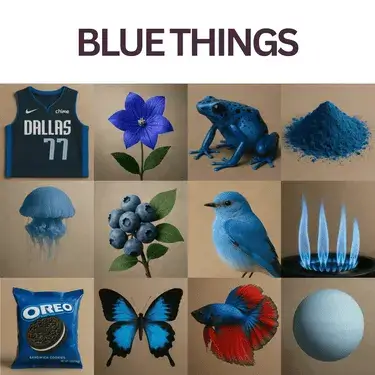
The photographs range from pale sky blue to violet-blue and blue-green. Those boundaries are useful when collecting color references: a blueberry, a bluebird and a jellyfish do not share one exact shade.
Blue in the natural world
Balloon flower
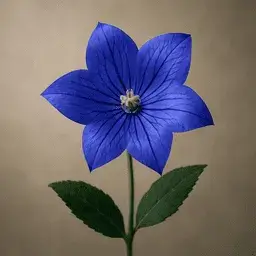
The balloon flower is named for its inflated buds, which open into broad, star-shaped blooms. Violet-blue varieties belong here, although the plant also comes in pink and white.
Blue Eyes
Blue eyes contain relatively little melanin in the front of the iris. Their color comes from the way light scatters there, rather than from a blue pigment.
Blueberry

A blueberry is a small study in surfaces: dark skin beneath a pale, waxy bloom. That coating gives the fruit its familiar dusty-blue appearance.
Uranus

At a very different scale, Uranus has a pale blue-green atmosphere. Methane absorbs red light and contributes to that appearance. NASA’s visible-light images of Uranus show a hazy planet rather than a royal-blue sphere.
Sky
Sunlight contains a range of colors. Air molecules scatter shorter visible wavelengths more strongly than longer ones, sending blue light toward us from across the daytime sky.
Blue Jellyfish

The jellyfish shown here has a translucent blue-violet appearance. Light passes through much of the bell, so its color looks less solid than the opaque blue of a petal or a painted surface.
Ocean
Clear ocean water absorbs red light more readily than blue light, helping blue dominate the light that returns to an observer. As NOAA explains, the sea’s color also varies with what is in the water; sediment and microscopic organisms can shift it toward green or brown.
Aster
Blue-violet rays surround a yellow center in some asters. Crop out the center and the same flower becomes a much quieter color reference.
Ulysses Butterfly
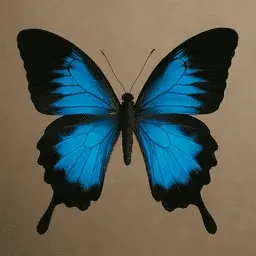
The upper wings of the Ulysses butterfly have lustrous blue areas bordered by black. The dark margins make the blue center especially distinct.
Mountain Bluebird
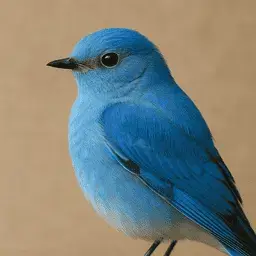
The butterfly’s blue sits inside a dark border; on a Mountain bluebird, it spreads through the plumage. The sexes also differ:
- Male: bright sky-blue plumage.
- Female: grayer overall, with blue in the wings and tail.
Indigo Milk Cap
The indigo milk cap, Lactarius indigo, carries blue beyond its cap: the gills and milky latex are blue too. The latex turns green on exposure. Color alone is not enough to identify a wild mushroom for eating.
Siamese fighting fish

The Siamese fighting fish, or Betta splendens, is kept in many captive color forms, including blue. Long fins can spread the color across a much larger area than the body itself.
Lapis lazuli
Lapis lazuli offers an opaque, irregular blue surface. It is a rock containing several minerals, which can produce three visible elements:
- An intense blue body color.
- White veins or patches.
- Gold-colored flecks, which are not actual gold.
Starfish
The blue sea star, Linckia laevigata, has five cylindrical arms and bright or light blue coloring. Yellow tube feet add a detail that is easy to miss in a view from above.
Blue dart frog
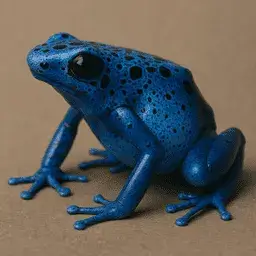
Black spots break up the blue skin of this poison dart frog. The limbs and belly can be darker than the back.
Blue Racer Snake
Adult blue racers can be bluish or gray above, with a pale underside. Young racers have markings that differ from the plainer adult appearance.
Blue Crayfish
Blue crayfish put the color on a hard shell. The common name covers different species and aquarium forms.
Blue and blue-purple foods
Blue Spirulina
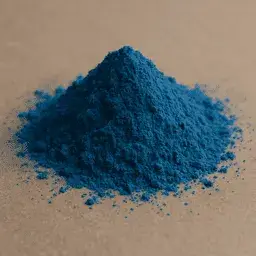
“Blue spirulina” usually means an extract containing the blue coloring protein phycocyanin. Whole spirulina biomass is blue-green; the separated extract is the ingredient used to give some drinks and other foods a brighter blue.
Blue Corn
Blue corn has blue-purple kernels and is used in foods such as tortillas and cornmeal. Its color comes from anthocyanin pigments. Grinding and cooking can change the appearance, so a finished tortilla may look grayer or more violet than the kernels.
Lingcod Fish
Unlike corn, where the color is visible on the kernels, lingcod may hide blue-green flesh beneath the skin. Not every fish has it. California Sea Grant describes a clear difference between the raw and cooked appearance:
- Raw: some individuals have blue-green flesh.
- Cooked: that blue-green flesh becomes white.
Blue cheese
In blue cheese, the color follows veins through a cream-colored background. Molds used in cheesemaking produce those blue-green markings.
Concord Grape
Concord grapes are dark blue-purple rather than sky blue. Their pale surface bloom can make a bunch look dusty or grayish in a photograph.
Everyday blue examples
Dallas Mavericks Jersey

A blue basketball jersey makes the color a deliberate design choice. Lettering and trim interrupt a large area of fabric, unlike the scattered spots on the frog or the narrow veins in blue cheese.
Oreo

The distinction is even simpler with Oreo: the wrapper is blue; the cookie and filling are not.
Gas flames

The last example changes the kind of color we are looking at. A jersey and a wrapper reflect light; a gas flame emits it. Its blue comes from combustion chemistry, including light emitted by excited molecules.