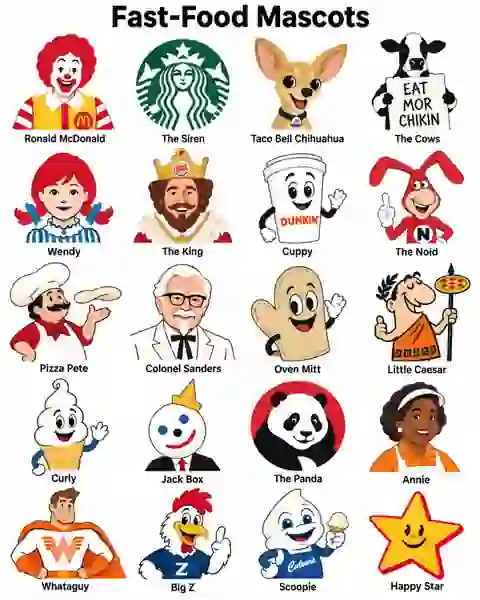
The selection includes historical advertising characters as well as logo figures.
Ronald McDonald — McDonald’s

A clown costume gives McDonald’s red and yellow somewhere to go beyond the packaging. Ronald’s yellow clothing carries the broadest area of color, while his red hair and shoes frame the figure from top to bottom.
The white face and striped sleeves break up that warm pairing. Our McDonald’s mascot guide follows the wider McDonaldland cast, including Grimace and the Hamburglar.
The Siren — Starbucks

The Starbucks Siren fills a green circle with white hair, a crown and two curling tails. Look at the outline without the lettering: the face sits between repeated curves, rather than on a full standing body.
Starbucks’ logo history traces the change from brown to green and the later removal of the brand name. The character now carries the logo on her own.
The Chihuahua — Taco Bell

A small dog with very large ears gave Taco Bell’s late-1990s advertising a character quite different from a clown or a cartoon chef. Gidget played the Chihuahua in those ads, as contemporary reporting records. Tan fur and dark eyes keep the animal’s appearance separate from Taco Bell’s purple bell logo. The ears supply most of the silhouette.
The Cows — Chick-fil-A

The cows are a group, rather than one named cow. Their Eat Mor Chikin signs give the campaign its premise: cattle would prefer you ordered chicken. In Chick-fil-A’s advertising, black-and-white patches leave room for the hand-painted lettering to stand out.
Wendy — Wendy’s

Red pigtails spread out on either side of Wendy’s face. The small collar and freckled cheeks add detail, but the hair sets the width of the portrait. In a red-and-white logo treatment, the empty white areas are as important as the red lines.
The King — Burger King
The crown, beard and royal clothing turn Burger King’s name into a person. Versions of the King have ranged from drawn figures to the large, fixed-face character used in advertising.
Gold belongs at the crown and costume trim. Giving every surface the same yellow would lose the distinction between metal, hair and fabric. The Burger King palette offers a separate reference for the brand’s colors.
Cuppy — Dunkin’

Dunkin’ introduces Cuppy as its mascot in a behind-the-scenes account. A takeaway cup supplies the body, so the character brings its packaging along wherever it goes. The illustration places pink and orange details on a mostly white cup. That leaves a broad plain surface for the face instead of filling it with several competing patterns.
The Noid — Domino’s
Long, floppy extensions rise from the Noid’s red hood. His hunched, mischievous appearance fits his role as an obstacle to pizza delivery. He is an antagonist with a job to do, even if the job is stopping dinner.
Domino’s 2021 campaign announcement brought the character back to television. The red suit is a much simpler color statement than the red-and-blue domino mark.
Pizza Pete — Pizza Hut
An apron, mustache, hat and checked neckerchief identify Pizza Pete in early Pizza Hut material. The Pizza Hut Museum documents his appearance on signs, cups and bags. His costume gives the drawing a cooking theme before any lettering is added. The checked neckerchief supplies a small pattern inside a much simpler outline.
Colonel Sanders — KFC
Colonel Sanders began as a real person: Harland Sanders, whose story appears in KFC’s history. His portrait became part of the brand’s visual identity. The white hair, glasses, goatee and dark string tie survive even in a reduced drawing. Around that portrait, KFC’s red panels provide a stronger field of color. The face can remain largely black and white.
Oven Mitt — Arby’s
Arby’s gave an oven mitt eyes, a mouth and a speaking role in its 2003 advertising. A production report on the commercials describes the animated character and Tom Arnold’s voice performance. The broad mitten shape makes an unusual body: one thumb stands apart from the rounded finger section. It needs very little anatomy to become expressive.
Little Caesar — Little Caesars
Little Caesar carries a pizza on a spear and wears an orange, Roman-inspired outfit. The joke is built into the props: an ancient-looking figure has arrived with takeaway pizza.
- Orange clothing supplies the main colored shape.
- Black outlines define the limbs, hair and costume edges.
- The pizza adds a separate round shape above the figure.
Curly — Dairy Queen
Curly turns a soft-serve cone into a walk-around character. Costume maker Loonie Times documents its Curly Cone costume for Dairy Queen. The swirl gives the top of the character its shape.
Jack Box — Jack in the Box
The Jack in the Box character’s oversized white ball-shaped head sits above a human body, with a small pointed hat on top. That change in proportion is the character’s central feature. A business suit makes the enormous head look even less like ordinary office attire.
The Panda — Panda Express
A black-and-white panda sits within the red Panda Express badge. The animal and the surrounding lettering do different work: the panda occupies the center, while the words follow the circular border.
Annie — Popeyes
Annie is a performed advertising character. Actor Deidrie Henry played the Popeyes spokesperson, a role described in her Portland Center Stage biography. A live performer brings voice, gesture and timing to the character.
Whataguy — Whataburger
Whataguy brings a superhero outline to Whataburger’s orange-and-white identity. The cape and large chest emblem give the costume a clear front and a flowing shape behind it. Whataburger’s origin story follows the character from children’s meal material to community appearances.
Big Z — Zaxby’s
Big Z is Zaxby’s chicken mascot. In the brand’s kindness campaign, signs let the character communicate without speaking. The sign supplies the words while the performer handles the gestures.
Scoopie — Culver’s
Scoopie is a scoop of frozen custard given a face and limbs. Culver’s mascot guide places Scoopie alongside Curdis, its cheese-curd character.
Happy Star — Carl’s Jr.
Happy Star fits a smiling face into a yellow five-pointed star. The points serve as the outer shape, leaving the center for the eyes and mouth. Carl’s Jr. includes the star in its brand history.
Fast-food characters at a glance
| Character | Restaurant | Character type |
|---|---|---|
| Ronald McDonald | McDonald’s | Costumed character |
| The Siren | Starbucks | Logo figure |
| The Chihuahua | Taco Bell | Historical advertising character |
| The Cows | Chick-fil-A | Campaign characters |
| Wendy | Wendy’s | Logo figure |
| The King | Burger King | Advertising character |
| Cuppy | Dunkin’ | Cup character |
| The Noid | Domino’s | Advertising character |
| Pizza Pete | Pizza Hut | Historical advertising figure |
| Colonel Sanders | KFC | Founder and brand figure |
| Oven Mitt | Arby’s | Historical advertising character |
| Little Caesar | Little Caesars | Cartoon brand character |
| Curly | Dairy Queen | Soft-serve character |
| Jack Box | Jack in the Box | Advertising character |
| The Panda | Panda Express | Logo figure |
| Annie | Popeyes | Historical advertising spokesperson |
| Whataguy | Whataburger | Superhero character |
| Big Z | Zaxby’s | Chicken character |
| Scoopie | Culver’s | Frozen custard character |
| Happy Star | Carl’s Jr. | Logo and mascot character |