Central African Republic

The flag uses five colors: blue, white, green and yellow form horizontal bands, while a red band cuts vertically through them.
The yellow star is in the upper blue band. The Central African embassy’s explanation connects it with the path toward freedom and emancipation.
The country was under French colonial rule before independence. French and Sango are its official languages.
South Sudan

The flag predates the country’s independence: it was adopted in 2005, while South Sudan became independent on 9 July 2011.
The South Sudanese embassy identifies blue with the Nile’s waters and describes yellow as a star guiding the country and its citizens.
Angola

The star shares Angola’s yellow emblem with a cogwheel segment and a machete. Its official meaning is international solidarity and progress. The red band commemorates Angolans killed under colonial rule, in the independence struggle and in defence of the country.
Portuguese is Angola’s official language.
Vietnam

One large, five-pointed yellow star fills the center of Vietnam’s red flag. Vietnam’s flag history follows the design through the country’s political changes.
Mozambique

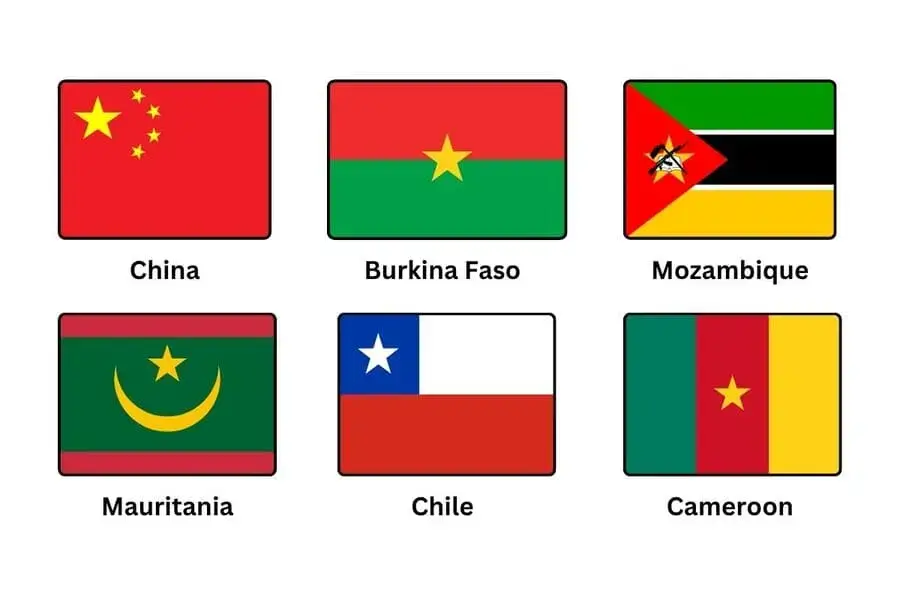
Mozambique’s flag places its yellow star inside the red triangle beside the pole. A book, hoe and rifle lie over the star, making it part of a larger emblem.
The country is on Africa’s Indian Ocean coast.
Mauritania

Both a crescent and a star appear in Mauritania’s flag. Both are yellow against green, with red bands along the upper and lower edges.
Most of the country lies in the Sahara.
Tuvalu

The symbol in the upper corner is the Union Jack, recalling Tuvalu’s former colonial relationship with Britain. Tuvalu has been independent since 1978.
The nine yellow stars represent the country’s nine islands. Their scattered arrangement follows the island group rather than forming a decorative circle.
Democratic Republic of Congo

A yellow star occupies the upper corner of the Democratic Republic of the Congo’s blue flag. A red diagonal band, edged in yellow, crosses below it.
Malaysia

Considering its red and white stripes, the flag resembles the United States Flag at first glance. However, the Malaysian flag has a 14-pointed yellow star and crescent.
Niue

Niue’s flag has a golden-yellow field, with a modified Union Jack in the upper corner. The Niue Flag Act describes five yellow stars within that corner:
- Four small stars sit on the arms of the cross.
- A larger star sits inside a blue disk at the center.
Niue is self-governing in free association with New Zealand.
Cameroon

Cameroon’s star sits in the middle of the red band, between vertical green and yellow bands. The gold star is part of the flag described in Cameroon’s constitution.
Ethiopia

The Ethiopian star has an interlaced outline inside a blue disk. Yellow rays extend between its five points, giving the emblem a more intricate shape than a solid star.
Cabo Verde

It resembles the European flag at the end of the list, but has ten stars and horizontal white–red–white bands. The stars form a circle toward the left of the blue field.
Cabo Verde is an Atlantic island country with ten main islands.
Grenada

Grenada has seven gold stars: three along the top border, three along the bottom and one in the center. The small symbol beside the pole is a nutmeg, a reference to the island’s spice trade.
Suriname

Suriname’s broad red middle band holds a single yellow star. Narrow white bands separate the red from the green at the top and bottom.
Burkina Faso

The yellow star on Burkina Faso’s flag straddles the meeting line of two equal bands: red above and green below.
China

All five of China’s yellow stars occupy one corner of a red field. One star is much larger than the other four.
European Flag (Comparison)

The European flag is included as a comparison: the EU is a union of countries. A ring of twelve gold stars sits against blue, and their number does not count member countries.
| Flag | Description |
|---|---|
| Central African Republic | Five colors; a yellow star in the blue band and a vertical red band |
| South Sudan | Yellow star in a blue triangle; flag adopted in 2005, independence in 2011 |
| Angola | Yellow star alongside a cogwheel segment and machete |
| Vietnam | One five-pointed yellow star centered on red |
| Mozambique | Yellow star behind a book, hoe and rifle in the red triangle |
| Mauritania | Yellow crescent and star on green, with red upper and lower bands |
| Tuvalu | Nine yellow stars representing nine islands |
| Democratic Republic of Congo | Yellow star above a yellow-edged red diagonal on blue |
| Malaysia | One fourteen-pointed yellow star beside a crescent |
| Niue | Golden-yellow field; five yellow stars within a modified Union Jack |
| Cameroon | Gold star in the red center band of a green–red–yellow tricolor |
| Ethiopia | Interlaced yellow star and rays on a blue disk |
| Cabo Verde | Ten yellow stars in a circle; white–red–white horizontal bands |
| Grenada | Seven gold stars and a nutmeg emblem |
| Suriname | One yellow star in the red middle band |
| Burkina Faso | Yellow star centered across red and green bands |
| China | One large yellow star and four smaller ones on red |
| European flag (comparison) | Comparison: twelve gold stars; number independent of EU membership |
Related Articles: Red White and Black Flag, Red, White And Blue Flags