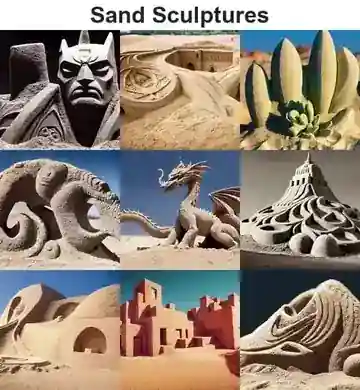
These images are visual references for forms and compositions, rather than a record of named artists or events. Look for the difference between a solid silhouette and a shape opened up by arches, loops or deep cuts.
1. Batman bust

The pointed ears and heavy brow make this bust recognizable before the finer texture comes into focus. Dark recesses around the eyes contrast with the lighter planes of the face.
2. Castle below the surface

Instead of rising above a flat base, this castle sits inside a sweeping hollow. The circular carving in front gives the foreground as much attention as the building.
3. Sweeping castle walls

The next castle stretches outward through long, curved walls. Their ridges carry the eye across the sand toward the small towers, making the route toward the building part of the design.
4. Cactus forms

Smooth cactus forms rise from rough ground. The rounded tips soften the outline after three sharply carved buildings.
5. Round towers

Repeated cylinders make the structure feel orderly. Smaller openings and bands cut into the towers break up what would otherwise be large, plain surfaces.
6. Curled creature

A curled body leaves an opening through the middle of the creature. That empty space matters as much as the head: it stops the figure from reading as a solid lump.
7. Winged dragon

The dragon opens the silhouette in several directions:
- Horns and a narrow snout extend forward.
- Wing ribs fan upward.
- The long tail curves behind the body.
Small shadows between those parts separate the details without adding another color.
8. Clustered castle

Conical roofs sit above a tightly packed group of towers. Compared with the broad curves of the earlier castles, this one builds its outline from many small peaks.
9. Spiral castle

Low, curling forms lead into a single central tower. Viewed together, they give the base a spiral pattern rather than the straight approach of a conventional castle.
10. Bridges and arches

Two scales of openings give this castle its depth:
- Large passages and arches near the base.
- Small windows higher up the towers.
11. Carved landscape

Here the buildings merge with a rolling landscape. A few deep openings provide dark focal points against the broad, sunlit slopes.
12. Rounded house

A rounded doorway and recessed windows give the house a compact face. Rough sand below the entrance makes the smooth wall stand out.
13. Hillside houses

Several houses are stacked into a low hill. Flat walls and deep rectangular openings create a different rhythm from the round towers above.
14. Block-shaped buildings

This image brings a warmer, reddish cast into the gallery. The block-like buildings are separated by sharp edges and narrow gaps, while the sky provides a cool blue contrast.
15. House with flowing walls

Flowing walls curve into the roof and around the openings. After the previous image’s straight blocks, these continuous surfaces almost hide where the wall ends and the roof begins.
16. Sand sneaker

The sneaker turns a familiar object into a study of repeated grooves. The ribbed upper, recessed side mark and thick sole remain legible within the sandy texture.
What to take from the gallery
For a first sketch, choose one feature to develop: the dragon’s open silhouette, the castle’s curved approach or the sneaker’s repeated grooves. In a mostly sandy palette, the deeper cuts supply the dark marks while the exposed surfaces catch the light.
More color and texture references
For a digital starting point, the sand color reference turns the material’s name into a screen swatch. If you enjoyed looking at light and dark areas within one surface, the gouache paintings offer another way to study edges, pale highlights and deeper shadows.