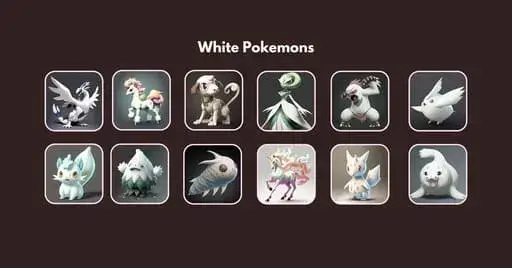
A pale shell, snowy fur and a translucent bell all call for different uses of white. These 41 Pokémon offer drawing and palette references across those surfaces, from Seel’s rounded body to Butterfree’s framed wing panels.
Some have only large white areas; others belong here in a particular regional form. The color suggestions below are our design interpretations, not official Pokémon color specifications. The existing 3D illustration is stylized; use official artwork when checking anatomy and exact markings.
Choose the kind of white first
Here are four starting combinations for a background, card or illustration inspired by the designs. The HEX values were selected for this article rather than sampled from official artwork.
DirectionLight baseSupporting toneSmall accentWhere to lookWarm fur#FFF8E7#607B9B#D8AF42Mareep, SmeargleSnow and ice#F5FAFF#ADCBDD#536C88Alolan Vulpix, BearticLight body, warm markings#FFFCF4#595862#DB604AScorbunny, ZangoosePale transparent forms#F8FAFF#D5DEEE#7D8AA5Nihilego
Try a combination in the palette visualizer, then adjust the area covered by each color. A large blue background and a tiny blue marking create very different results with the same swatch. Check text contrast separately if you use these colors in an interface.
Seel
Seel begins the Seel–Dewgong family. Its pale body, small horn and darker nose give a drawing a clear starting point: keep the broad body light, then use a few dark marks to describe the face. A slightly warm ivory can soften the body against a cool blue background.
Rapidash
A cream body surrounded by orange-red flames gives the familiar Fire-type Rapidash a warm appearance. The Galarian form takes a different direction, with a pale body and pastel mane. It is Psychic/Fairy. Choose a form before collecting color references: the flame palette and the pastel palette belong to different designs.
For a fire-inspired poster, leave the cream across the largest area and concentrate orange around the mane and tail. A lavender-and-mint treatment suits the Galarian direction better.
Togetic
The small red and blue triangles on Togetic interrupt a mostly white body. A few well-spaced marks are enough for a simplified pattern. Leave open white space between them rather than scattering equal amounts of every color. Togetic is Fairy/Flying and sits between Togepi and Togekiss in its evolution family.
Pachirisu
Pachirisu pairs white fur with pale blue along its ears and large tail. Its yellow cheek patches are small, warm details within that cooler arrangement. This Electric-type Pokémon offers a useful three-color study:
- White for the main body.
- Soft blue to carry the tail shape.
- A little yellow near the face.
In an icon, enlarging the yellow patches would change that balance. Start with their position and scale before adjusting the hue.
Snover
The snowy upper half and brown lower section of Snover suggest two materials on the same body. Green at the hands adds a third, smaller area. Its Grass/Ice typing fits that plant-and-snow appearance. Try drawing the boundary between the pale and brown sections first; it gives a small illustration more definition than an extra shade of white would.
Vigoroth
Vigoroth is the Normal-type middle stage between Slakoth and Slaking. White fur covers most of its body, with a red tuft on its head and dark claws. The tuft is a useful accent for a mostly monochrome sketch. Keep it separate from the dark hands and feet so those details do different jobs in the composition.
Togekiss
Togekiss spreads white across a much wider wing shape than Togetic. The red and blue markings remain small. When comparing the two, look at the amount of empty pale space around each mark: the same accent colors produce a different pattern on a broad silhouette. Togekiss is Fairy/Flying and evolves from Togetic.
Gardevoir
Gardevoir combines a long white, dress-like shape with green around the head and upper body. A small red chest detail interrupts the center. Its Psychic/Fairy typing and flowing outline distinguish it from Gallade, another evolution branch from Kirlia.
For a palette study, let the white area establish the shape. Green can frame its upper edge, while muted red stays confined to one small point. Giving all three equal space would lose the proportions that make this design interesting.
Smeargle
The paint-tipped tail makes Smeargle a natural subject for a color site. This Normal-type Pokémon has a pale cream body, brown details and green paint on its usual tail design. Try using the cream as the paper or canvas color, then place a loose green stroke beside the character. That borrows the painting motif without adding several unrelated accent colors.
Ponyta
Ponyta's pale body provides a quiet area beside a bright flame mane in its familiar Fire-type form. Galarian Ponyta has a pastel mane and is Psychic-type. Either can anchor a light palette, but the temperature of the supporting colors changes considerably.
For warm and cool background options, compare the Red and Blue references beside the form you are drawing. A deep background will make the pale body stand out more than another near-white fill.
Lugia
Lugia has large wing-like arms and a pale body with blue on the belly and darker blue markings. It is Psychic/Flying. The broad blue belly area gives the white outline an internal shape, which helps when the figure is reduced to a small graphic.
A muted Green background is another option for a fan-art layout. Keep its value far enough from the body to show the outer edge, then compare it with a blue background before choosing.
Corsola (Galarian form)
Galarian Corsola is the pale form relevant here. Its Ghost typing and evolution into Cursola belong to that regional form. The familiar pink-and-white Corsola is Water/Rock and does not share that evolution.
In the Galarian design, a restrained gray outline can separate the branching white shapes from a pale background. On darker paper, the same branches can remain almost entirely white.
Vulpix (Alolan form)
Alolan Vulpix uses white fur, icy blue details and curled shapes around the head and tail. It is Ice-type. The reddish-brown Vulpix is the Fire-type form, so a white fox reference should identify the Alolan version.
A trace of pale lavender in the shadows is one possible drawing choice. Leave the tail tips lighter so the curls remain separate.
Shelgon
The shell occupies most of Shelgon’s visible surface, leaving a small dark opening for the eyes and short legs below. This Dragon-type Pokémon evolves from Bagon and later becomes Salamence. Use off-white for the shell and a middle gray at its overlapping edges. The dark face opening needs much less space than either of those tones.
Gallade
Angular green arms and a white lower body give Gallade a sharper outline than Gardevoir. It is Psychic/Fighting, with Kirlia in its evolution family. The red chest detail can stay tiny in a palette sketch. Focus on where the green arm shapes meet the white body; that boundary carries more information than a complicated background.
Vanilluxe
Vanilluxe's paired heads and pale blue ice forms give a white palette several distinct edges. It is an Ice-type Pokémon in the Vanillite–Vanillish–Vanilluxe family. Its frozen, soft-serve-like appearance suggests white highlights over cooler blue shadows. Keep the cone-like lower forms a shade darker if they disappear against the background.
Litwick
A small violet flame sits above the waxy white body of Litwick. Yellow in the visible eye supplies another accent. This Ghost/Fire Pokémon works as a compact color reference because the areas are so different in size.
- Use most of the light area for the candle body.
- Reserve violet for the flame and its immediate glow.
- Keep yellow to a small facial detail.
A charcoal background is one way to give the pale wax a clear edge.
Beartic
Beartic’s pale fur and blue, icicle-like beard offer a material comparison within one Ice-type design. The coat reads as a broad soft mass; the beard has pointed edges. In a drawing, a slightly warmer white on the fur can distinguish it from the colder blue around the chin without requiring a dark outline everywhere.
Cubchoo
Cubchoo places a pale blue head over a white lower body. It is Ice-type and evolves into Beartic. The blue nose detail hangs below the face, so keep it distinct from the chest when simplifying the character. A middle blue between the light head and a darker outline can preserve that separation in a small illustration.
Froslass
Froslass has a white, robe-like body, a dark face opening and a red band around its middle. This female Ice/Ghost Pokémon belongs to the Snorunt family. In a simplified design, the band establishes a strong horizontal break across the pale figure.
Compare a muted red with a brighter coral red for that accent. The brighter choice will draw more attention to the middle, so judge it at the size of the finished drawing.
Regigigas
The pale body of Regigigas is interrupted by yellow bands, black linework and green, moss-like areas. It is a Normal-type Pokémon with no evolution listed in its Pokédex entry. Its design is useful for studying several colors around a light base: connect the yellow bands across the figure, then leave the green in larger, uneven patches.
Tynamo
A yellow stripe runs along the narrow pale body of Tynamo. This Electric-type Pokémon begins the family that continues through Eelektrik to Eelektross. With such a slender shape, a thin warm line may be enough for a small badge or pattern. A second bright accent would compete with the stripe rather than explain another part of the design.
Silcoon
Silcoon is a Bug-type cocoon in Wurmple’s evolution family and develops into Beautifly. Most of its visible surface is pale silk, with a small red eye. Try a few gray strand edges around the white mass, leaving the eye as the only strong color. Dense shading across the entire cocoon would make the simple surface harder to read.
Swanna
White wings, a pale blue chest area and a yellow bill form Swanna’s main color arrangement. This Water/Flying Pokémon evolves from Ducklett. On a light page, a blue-gray background or a few shadow edges can separate its spread wings from the empty space around them. Keep the yellow at the head so it does not pull the whole image toward a warm palette.
Reshiram
Reshiram is Dragon/Fire, with a largely white body, feather-like forms and a large tail structure. White still needs several values in a drawing: the overlap of a wing, neck and torso can disappear if every surface receives the same fill.
Start with the white silhouette. Add a cool gray beneath overlapping shapes, then reserve the lightest areas for the edges facing the light. This approach follows the form instead of filling every feather with a different hue.
Furfrou
Furfrou is a Normal-type Pokémon whose grooming trims change its appearance. Trims are not evolutions. Its natural appearance combines a large pale coat with dark skin visible at the face and legs. If you are choosing colors from a trimmed design, name that trim first: the colored details and exposed shapes vary.
Swirlix
The cotton-candy-like coat on Swirlix leans toward a warm white, with pink details around the face and feet. It is Fairy-type and evolves into Slurpuff. Try a cream background with a slightly darker pink outline for a soft illustration, or move to a cool background when the pale coat needs more separation.
Passimian
Passimian is Fighting-type and has no evolution listed in its Pokédex entry. White fur, dark limbs and a green head covering create three broad color areas. The berry it carries adds another rounded shape to consider.
Before choosing individual shades, draw those light, dark and green areas as flat blocks. Their placement establishes the design even with a limited palette.
Drampa
The long pale hair on Drampa surrounds a muted green body. Drampa is Normal/Dragon and has no evolution listed in its Pokédex entry. Curving strands give this palette a different texture from the smooth shells and sharp ice forms elsewhere in the list. Leave gaps between the white strands so the green body remains visible.
Nihilego
Nihilego has a translucent, bell-shaped upper form and long, pale appendages. It is a Rock/Poison Ultra Beast. For a drawing on white paper, use a restrained blue-gray edge and let some of the background show through the form. That suggests transparency more convincingly than filling every pale area with opaque white.
Pheromosa
Long antennae and exceptionally slender limbs define Pheromosa’s outline. This Bug/Fighting Ultra Beast combines pale cream sections with yellow details. A thin silhouette leaves little room for interior shading, so start with the outline and the main joints. Use a middle-tone background if the limbs vanish on a white page.
Wingull
Wingull stretches blue bands across long white wings, with a warm yellow-orange bill at the center. It is Water/Flying and evolves into Pelipper. A repeating wing pattern can borrow the blue bands without using an equal amount of blue everywhere. Leave the body white and concentrate the warm accent near the head.
Scorbunny
Orange ear tips and feet interrupt the white body of Scorbunny. This Fire-type Pokémon begins the Scorbunny–Raboot–Cinderace family. The warm details appear at the ends of the figure, so they remain separated by a large pale center. That placement is worth keeping in a simplified sticker or small character study.
Solgaleo
Solgaleo is Psychic/Steel and is one of Cosmoem’s evolution branches. White shapes spread outward around its dark face, with gold-orange details near the mane. A golden yellow is one possible accent for a design inspired by that arrangement.
Keep the dark face area intact before adding the bright outer details. It gives the surrounding white shapes a clear center.
Dewgong
Dewgong evolves from Seel and adds Ice to the family’s Water typing. Its largely white body gives the nose, mouth and flipper edges particular importance in a small drawing. A cool shadow below the body can describe its rounded volume while leaving the upper surface almost unshaded. Compare it with Seel’s warmer-looking pale coat when planning the pair.
Vanillish
Vanillish sits between Vanillite and Vanilluxe in an Ice-type evolution family. White snow-like forms cover a blue, pointed lower body. Use a little more blue under the overhanging white shape to show that change in material. The small face details need only a dark line or dot, rather than another saturated color.
Mareep
The wool on Mareep looks closer to cream than a stark white. Blue skin and dark-and-yellow stripes give this Electric-type design a warmer character than many of the icy examples here. A cream swatch beside white paper makes that difference easier to judge. Keep the striped details small when building a palette from the larger wool and skin areas.
Zangoose
Zangoose cuts strong red markings across white fur, with dark claws adding a third value. It is Normal-type and has no evolution listed in its Pokédex entry. The red shapes are large enough to affect the outline of a simplified drawing. Follow their direction across the face and torso before deciding how bright to make them.
Darumaka (Galarian form)
The white example is Galarian Darumaka, an Ice-type regional form with pale fur and cool blue details. The familiar red Darumaka is Fire-type. Galarian Darumaka belongs to the Galarian Darmanitan family.
A compact palette can use white for the round body, pale blue for smaller areas and a dark tone around the face. Leave the red-bodied form out of a white-form reference board unless the purpose is to compare them.
Sandshrew (Alolan form)
Alolan Sandshrew has a pale blue-white, plated appearance and is Ice/Steel. The sand-colored Sandshrew is Ground-type. Both lead to their corresponding Sandslash forms. In the Alolan design, blue-gray seams can divide the pale plates. Keep the seams narrower than the surfaces they outline so the body remains predominantly light.
Butterfree
White wing panels sit within a dark border on Butterfree, while the body is purple and the eyes are red. It is Bug/Flying, following Caterpie and Metapod in its evolution family. The wings explain its place in this list even though the whole character is not white.
For a pattern inspired by the wings, begin with the dark border, leave the interior pale and add purple only where a second shape needs separating. Reproducing every small wing division is less important at thumbnail size.
Form references and related reading
For regional-form comparisons, see the official Pokédex entries for Galarian Corsola, Alolan Vulpix, Galarian Darumaka and Alolan Sandshrew. The official Pokédex also provides the species and evolution references used here.
Related Article: White Cartoon Characters, Brown Pokemon, Pink Pokemon, Pink Pokemon, Brown Pokemon