European Union

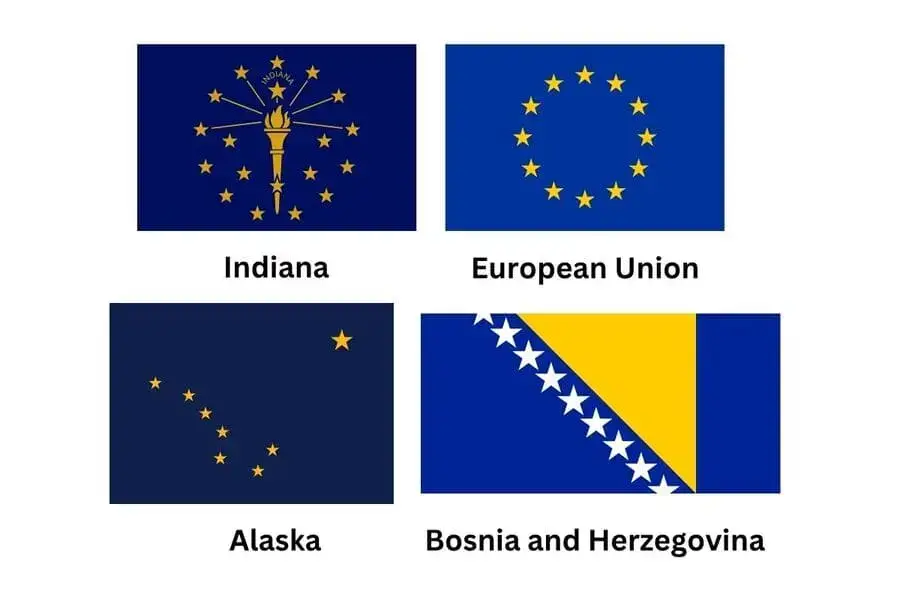
The European flag has twelve gold stars arranged in a circle on blue. Their number is fixed, rather than a count of EU member countries. The circle represents unity, solidarity and harmony.
The Council of Europe adopted the design in 1955. The European institutions later adopted the same flag; these are separate organizations, not successive names for one institution.
Alaska

Benny Benson designed Alaska’s flag for a schoolchildren’s contest in 1927, while Alaska was still a US territory. His winning design became its flag before statehood.
Seven gold stars form the Big Dipper, part of Ursa Major. The larger eighth star is Polaris, the North Star.
Indiana

Indiana became the nineteenth US state in 1816; the flag followed in 1917. Its central torch is surrounded by nineteen gold stars on blue.
The state’s description divides them into three groups: thirteen for the original states, five for the next states admitted, and a larger star above the flame for Indiana. The torch represents liberty and enlightenment.
Bosnia and Herzegovina

A yellow triangle cuts across Bosnia and Herzegovina’s blue field. A diagonal line of white stars follows its sloping edge, with partial stars at the top and bottom. This flag shares the blue-and-yellow palette, though its stars are not yellow.
The flag law took effect on 4 February 1998.
| Flag / entity | Description |
|---|---|
| European Union | Twelve gold stars in a circle |
| Alaska | Eight gold stars: Big Dipper and North Star |
| Indiana | Nineteen gold stars surrounding a torch |
| Bosnia and Herzegovina | Yellow triangle with a diagonal row of white stars |
Plus: Flag coloring pages
Related Articles: Blue Black White Flag, Red White Blue Flag With One Star