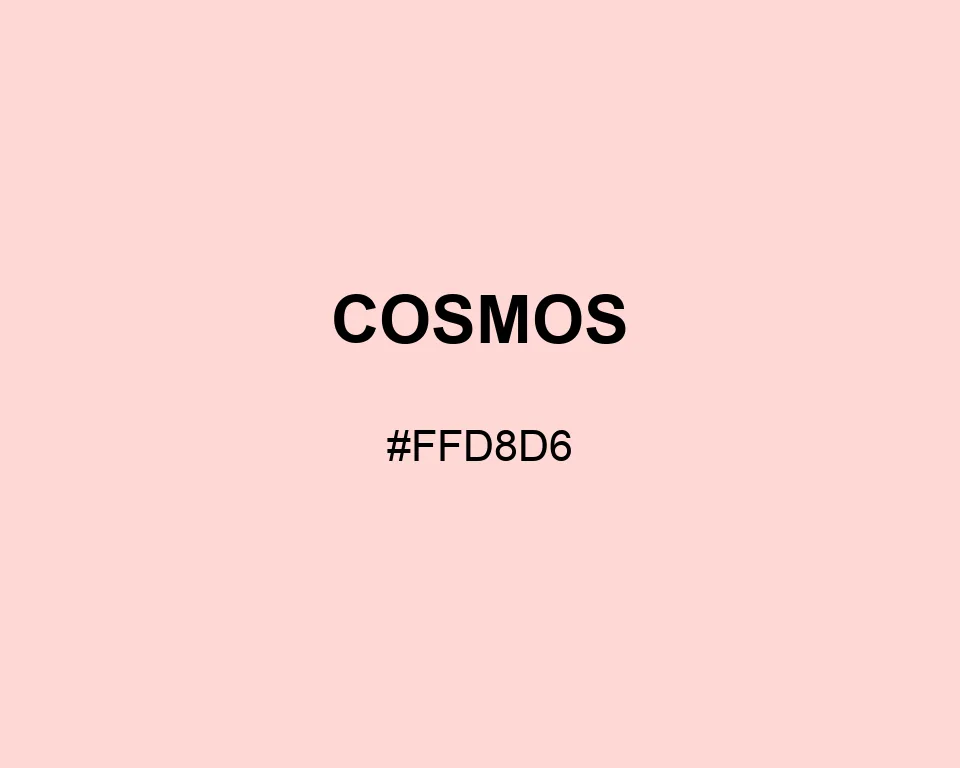
Cosmos reads as petal pink until it meets a cooler blush. Then a small orange warmth appears. The shift makes it useful in layered floral palettes.
| Color model | Value | Common use |
|---|---|---|
| HEX | #FFD8D6 | Web and interface color |
| RGB | rgb(255, 216, 214) | Digital screens |
| HSL | hsl(3, 100%, 92%) | Hue-based adjustments |
| HSV | hsv(3, 16%, 100%) | Color pickers |
| CMYK | 0%, 15%, 16%, 0% | Print reference |
#ffd8d6
#355e3b
#a8c2a3
#27372a
#ffd8d6
#800020
#c48694
#3e1d25
#ffd8d6
#6a5acd
#b7afe4
#34304e
#ffd8d6
#8b9c90
#d2d9cf
#455047
A floral name suits this swatch because the color is neither plain pink nor cream. It changes with its neighbors. Cool lilac pushes it peachward, while terracotta makes it seem pinker.
Use burgundy for fine botanical captions. Slate blue is gentler and lets the pale field remain the focus.
In its RGB recipe, green lands at 216 and blue at 214 inside #FFD8D6. With red fixed at 255, that almost level lower pair produces the warm petal effect.

#ffd8d6
#ffdcda
#ffe0de
#ffe4e2
#ffe8e6
#ffecea
#ffefef
#fff3f3
#fff7f7
#fffbfb
#ffffff
#ffd8d6
#e6c2c1
#ccadab
#b29796
#998280
#806c6b
#665656
#4c4140
#332b2b
#1a1615
#ffd8d6
#ffffff
#ffffff
#a68c8b
#d1b1af
#ffd8d6
#ffdfdd
#ffe6e4
#ffffff
#ffd8d6
#ffffff
#ffd8d6
#ffffff