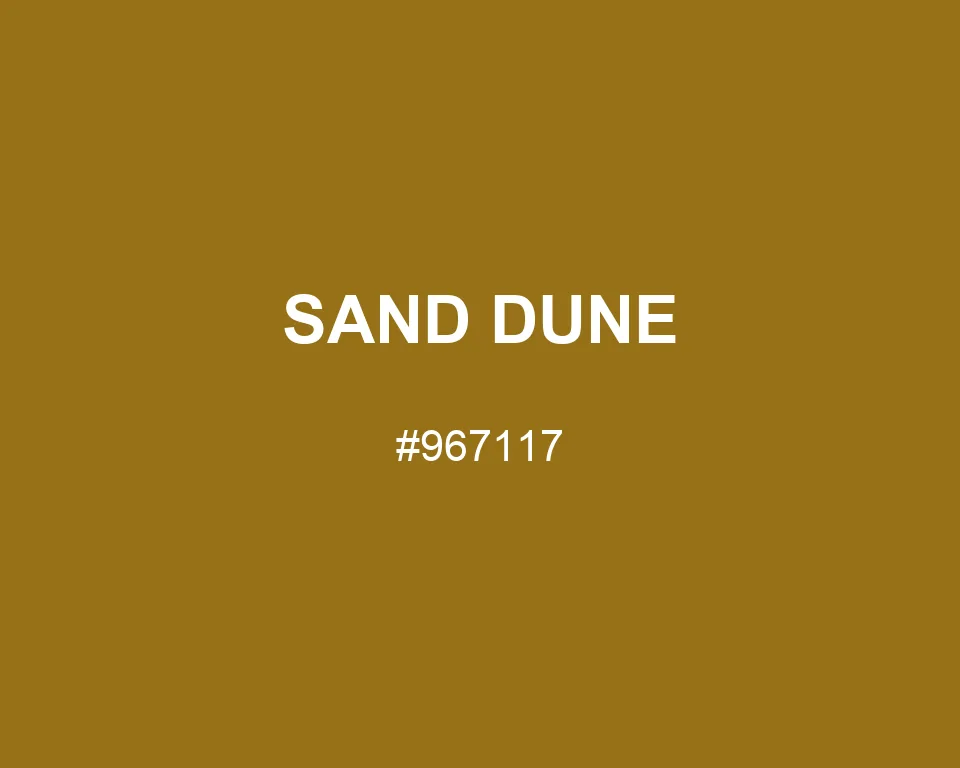
Sand Dune
This is not pale beach sand. #967117 belongs to compacted earth and shadowed ridges, where yellow remains visible inside a dark mineral brown.
Color Conversions
| Color model | Value | Common use |
|---|---|---|
| HEX | #967117 | Web and interface color |
| RGB | rgb(150, 113, 23) | Digital screens |
| HSL | hsl(43, 73%, 34%) | Hue-based adjustments |
| HSV | hsv(43, 85%, 59%) | Color pickers |
| CMYK | 0%, 25%, 85%, 41% | Print reference |
Real Design Examples 👇🏽
Color Combinations
Canyon Blue Survey
#967117
#345f74
#7f9ba7
#203a46
Juniper Trail Marker
#967117
#425c47
#829084
#29392d
Weathered Canvas Notes
#967117
#d2c3a3
#94856a
#463e32
Rust Ridge Contour
#967117
#98513a
#c88770
#553127
Other Color Collections
Fashion
Interior
Wallpapers
Patterns
Best Match
The swatch contains 150 red against 113 green and 23 blue. Those uneven steps make #967117 deep ochre rather than ordinary tan.
Use canyon blue to mark water or distance on an arid map. Juniper gives the brown a hardy botanical companion, while weathered canvas builds a low-contrast system for field notes and outdoor labels.
This is the shaded side of a dune, not its sunlit crest. Sand Dune carries the weight of iron-rich earth and reads especially well beside cool colors drawn from sky, stone, or dry vegetation.