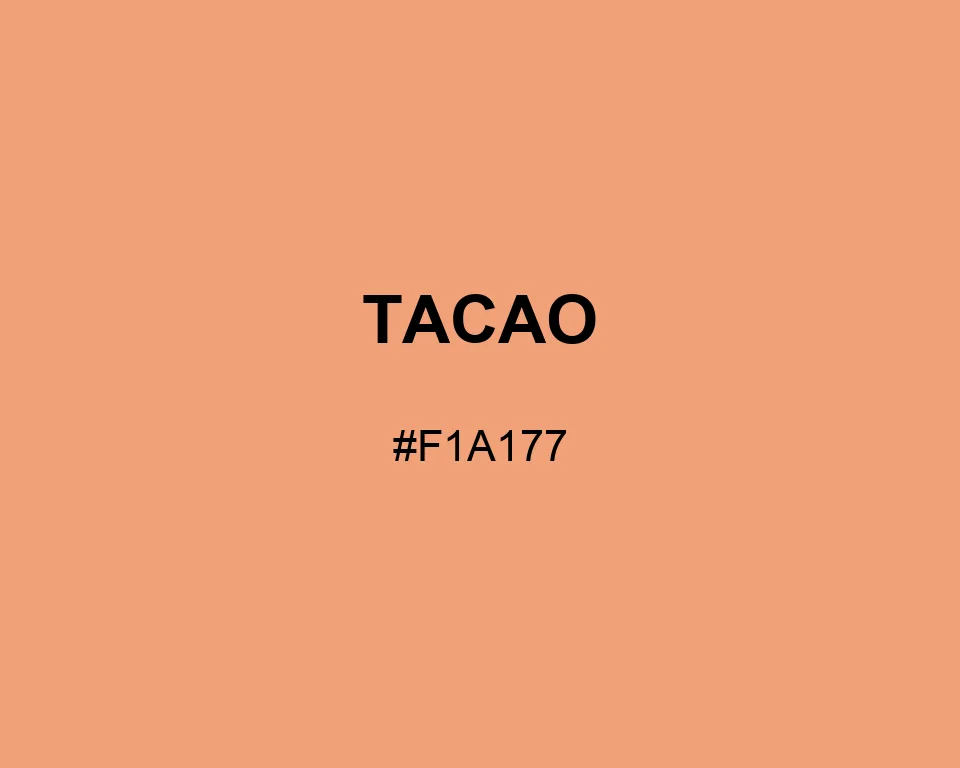
Tacao feels like sun-warmed clay after a thin peach wash, with less candy brightness than most coral oranges.
| Color model | Value | Common use |
|---|---|---|
| HEX | #F1A177 | Web and interface color |
| RGB | rgb(241, 161, 119) | Digital screens |
| HSL | hsl(21, 81%, 71%) | Hue-based adjustments |
| HSV | hsv(21, 51%, 95%) | Color pickers |
| CMYK | 0%, 33%, 51%, 5% | Print reference |
#f1a177
#0047ab
#8faad0
#22334c
#f1a177
#bab86c
#d4c89c
#4c4932
#f1a177
#6b4636
#b78269
#382a23
#f1a177
#4b0082
#9a70b2
#2d183a
On matte paper, Tacao lands closer to fired terracotta than fruit, though the pale red lift keeps it from feeling brown.
The red channel reaches 241. Green sits at 161 and blue at 119. Those uneven drops give #F1A177 an RGB profile of 241, 161, and 119 with a coral-orange bias.
Bring in cobalt blue when the layout needs a hard, cool boundary. For a softer route, spread olive green across the larger field and reserve Tacao for clay-colored details.

#f1a177
#f2aa85
#f4b492
#f5bda0
#f7c7ad
#f8d0bb
#f9d9c9
#fbe3d6
#fcece4
#fef6f1
#ffffff
#f1a177
#d9916b
#c1815f
#a97153
#916147
#78503c
#604030
#483024
#302018
#18100c
#f1a177
#aef1c5
#c5aef1
#9d694d
#c68462
#f1a177
#f4b28f
#f6c2a7
#f1aeb8
#f1a177
#f1e7ae
#f1a177
#aedaf1