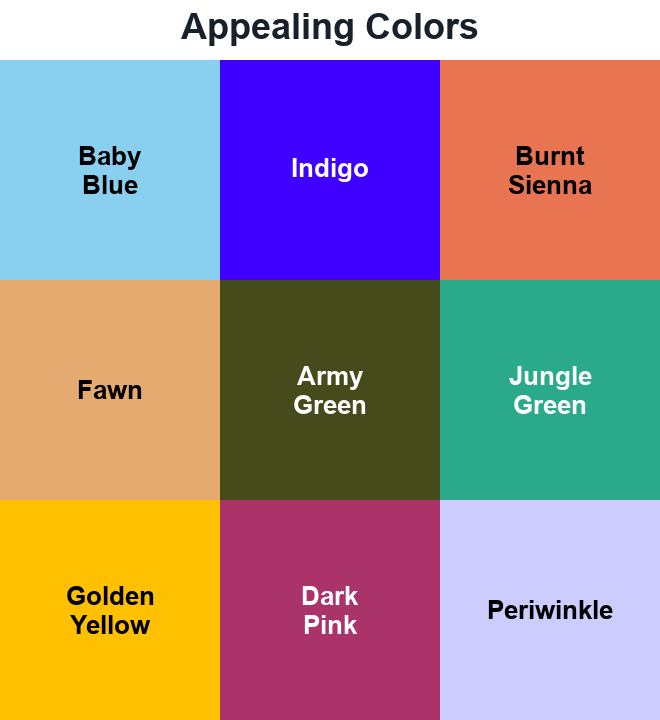
| Color | HEX |
|---|---|
| Baby Blue | #89CFF0 |
| Cornflower Blue | #6495ED |
| Indigo | #3F00FF |
| Neon Blue | #1F51FF |
| Sky Blue | #87CEEB |
| Burnt Sienna | #E97451 |
| Fawn | #E5AA70 |
| Red Brown | #A52A2A |
| Wheat | #F5DEB3 |
| Sage Green | #8A9A5B |
| Army Green | #454B1B |
| Emerald Green | #50C878 |
| Jungle Green | #2AAA8A |
| Mint Green | #98FB98 |
| Golden Yellow | #FFC000 |
| Dark Pink | #AA336A |
| Pastel Pink | #F8C8DC |
| Periwinkle | #CCCCFF |
Appeal depends on the combination, the product and the audience. Research on product-color choices links those choices to personal preferences and color associations, so these examples are starting points rather than promises of higher sales.
Blues and violet for backgrounds or emphasis
Baby Blue — #89CFF0

Baby Blue gives a white product photograph a gently colored surround. It is a quiet starting point for a page with plenty of imagery.
Cornflower Blue — #6495ED

Cornflower Blue is deeper and more violet than Baby Blue. It suits a broad stripe on packaging or the colored side of a split layout; cream gives that combination a softer edge than brilliant white.
Indigo — #3F00FF

#3F00FF is a saturated violet-blue. The name Indigo has several reference values; the code identifies this particular sample. An orange accent creates a vivid warm–cool pairing, while a pale neutral keeps the emphasis on the blue-violet itself.
Neon Blue — #1F51FF

A thin Neon Blue outline stays conspicuous against white. Filling the shape with the same blue makes it a much stronger element.
Sky Blue — #87CEEB

Sky Blue and Baby Blue are close relatives in this selection. Sky Blue is slightly darker and greener, a useful distinction when choosing between two otherwise similar backgrounds.
Earthy greens and warm neutrals
Burnt Sienna — #E97451

Burnt Sienna introduces a clay-like orange to the list. Against cream and dark brown, it can give a label or product card a warm, earthy palette. A small blue detail makes the orange more pronounced.
Fawn — #E5AA70

Fawn is lighter and less red than Burnt Sienna. Its tan-orange cast works alongside leather-colored photography, kraft paper or a warm off-white, where a cool gray might look disconnected.
Red Brown — #A52A2A

Red Brown gives the warm group its dark anchor. With the two nearby neutrals, it forms a small palette with distinct jobs:
- Wheat: the broad, light surface.
- Fawn: a warmer middle tone for blocks or illustrations.
- Red Brown: lettering, borders or a deeper graphic shape.
Wheat — #F5DEB3

Wheat has a distinctly yellow cast. It makes a warmer page background than white and leaves room for brown illustrations, red details or dark typography without adding another strong hue.
Sage Green — #8A9A5B

The Sage Green swatch here is olive-leaning, rather than the gray-green sometimes sold under the same name. Next to Wheat it reads as earthy; next to a pale pink, the green-yellow undertone is easier to see.
Army Green — #454B1B

The darkest green here has enough yellow in it to sit comfortably beside Fawn and cream. Try Army Green in the place of dark brown when that warm palette needs a change.
Emerald Green — #50C878

After the two olives, Emerald Green looks noticeably clearer and brighter. A large illustrated leaf or a solid green panel shows that difference better than a tiny decorative mark.
Jungle Green — #2AAA8A

Jungle Green moves toward teal. Compare it with Emerald: the extra blue becomes especially apparent beside the orange of Burnt Sienna. That pairing offers a warm–cool split without using a primary blue.
Mint Green — #98FB98

This Mint Green sample is a light, vivid yellow-green. Spread across a panel, it has more presence than the name might suggest; it is closer to a bright spring green than a muted pastel.
Yellow, pink and periwinkle accents
Golden Yellow — #FFC000

Golden Yellow changes character with the amount you use:
- A narrow band adds a bright interruption to cream and brown.
- A full yellow panel becomes the main colored area; dark lettering gives it a clear foreground.
Dark Pink — #AA336A

This berry-like pink gives the selection a deeper rosy tone. On a small label or a block of lettering, it holds its shape more clearly against a pale background than Pastel Pink does.
Pastel Pink — #F8C8DC

Pastel Pink beside the olive Sage sample creates a mix of warm pink and yellow-green. Keeping the pink area larger lets the olive act as a compact accent rather than an equally strong block.
Periwinkle — #CCCCFF

Periwinkle bridges the pale blues and pinks. In an illustration containing both, it can fill the space between them without introducing a markedly different hue.
Build out the color you want to keep
Choose one of these colors as the starting point, then try a lighter or deeper neighbor before adding another hue. If Baby Blue is close but too bright, the soft blue shades offer more subdued alternatives. For a pink-led palette, compare the dark pink shades with Pastel Pink to find a depth that suits the design.