Switzerland

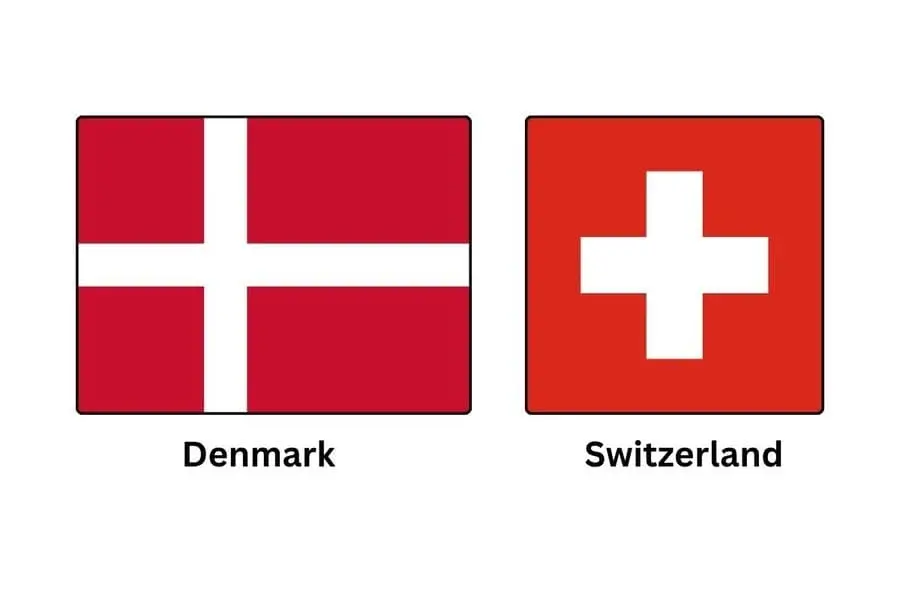
Switzerland’s flag has a 1:1 ratio. To put it colloquially, the flag is square.
There are very few square national flags, and Switzerland’s flag is one of them. Vatican City’s is square too.
The white cross on red has older military roots. The Swiss federal authorities date the national emblem’s official adoption to 1848; the cross’s proportions were defined in 1889.
During the Helvetic Republic (1798–1803), a green, red and yellow tricolor replaced the cross design. It did not last beyond that regime.
Denmark

This flag also uses a red background, but its shape is rectangular.
The white cross reaches all four edges. Its upright arm is shifted toward the flagpole, unlike Switzerland’s centered, free-standing cross.
Known as Dannebrog, it is one of the world’s oldest national flags still in use. The story that it fell from the sky in 1219 is a legend; documented use dates to the 14th century.
Chronological Historical Events
1814: Denmark’s union with Norway ended.
1854: Private citizens were allowed to use Dannebrog, according to the Danish embassy’s history.
1940: Denmark had remained neutral during the First World War, but Nazi Germany invaded it on 9 April 1940 during the Second World War.
1973: Denmark joined the European Communities, the predecessor of today’s European Union. It was not a founding member.
Last Words
How Do the Two Flags Differ?
- Switzerland: square flag, with red space around every end of the cross.
- Denmark: rectangular flag, with a cross that reaches the edges and sits closer to the pole.
Related Articles: Blue Flag With White X, White Flag With Red Cross