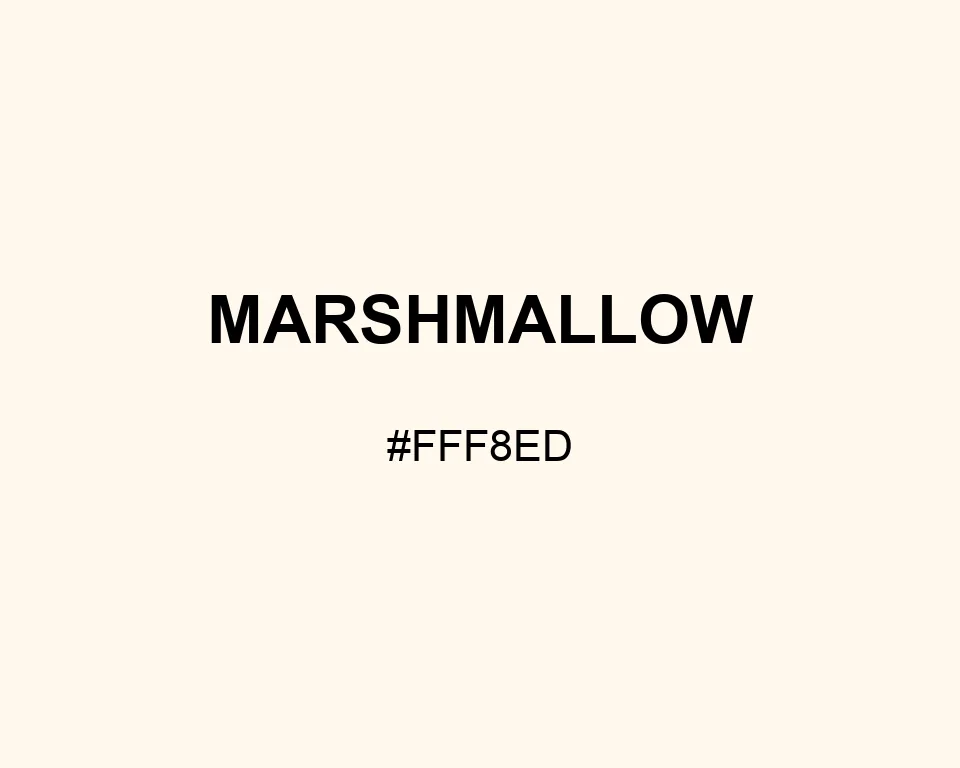
Marshmallow is not a hard white. A trace of toasted cream sits underneath. That tiny shift makes large blank areas feel softer.
| Color model | Value | Common use |
|---|---|---|
| HEX | #FFF8ED | Web and interface color |
| RGB | rgb(255, 248, 237) | Digital screens |
| HSL | hsl(37, 100%, 96%) | Hue-based adjustments |
| HSV | hsv(37, 7%, 100%) | Color pickers |
| CMYK | 0%, 3%, 7%, 0% | Print reference |
#fff8ed
#6b4636
#b99179
#342721
#fff8ed
#800020
#c78a99
#3c1d25
#fff8ed
#b0e0e6
#658a93
#33494f
#fff8ed
#8b9c90
#cfd8ce
#465149
On a screen filled with bright white, Marshmallow makes a gentle inset panel. The boundary is visible. It does not need a heavy border to separate the two surfaces.
Try burgundy for a confectionery label, or powder blue when the layout should feel cooler and more open.
Very little separates the three RGB channels: #FFF8ED records 255 red, 248 green, and 237 blue. Across that narrow eighteen-level span, white picks up its toasted impression.

#fff8ed
#fff9ef
#fff9f1
#fffaf2
#fffbf4
#fffcf6
#fffcf8
#fffdfa
#fffefb
#fffefd
#ffffff
#fff8ed
#e6dfd5
#ccc6be
#b2aea6
#99958e
#807c76
#66635f
#4c4a47
#33322f
#1a1918
#fff8ed
#ffffff
#ffffff
#a6a19a
#d1cbc2
#fff8ed
#fff9f0
#fffaf3
#ffffff
#fff8ed
#ffffff
#fff8ed
#ffffff