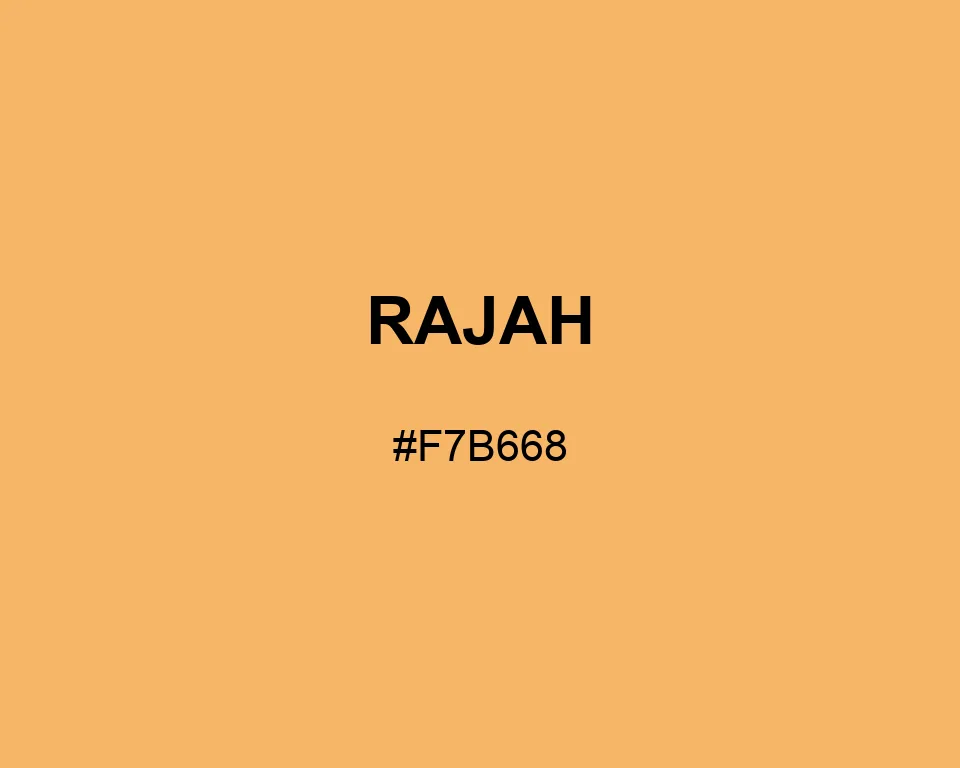
Rajah sits between honey and apricot. It has more weight than pastel peach but none of burnt orange's brown edge.
| Color model | Value | Common use |
|---|---|---|
| HEX | #F7B668 | Web and interface color |
| RGB | rgb(247, 182, 104) | Digital screens |
| HSL | hsl(33, 90%, 69%) | Hue-based adjustments |
| HSV | hsv(33, 58%, 97%) | Color pickers |
| CMYK | 0%, 26%, 58%, 3% | Print reference |
#f7b668
#4b0082
#9b74af
#2c1839
#f7b668
#8b9c90
#c9c4a4
#465047
#f7b668
#614051
#a98277
#34262d
#f7b668
#6a5acd
#aaa2ca
#343049
Rajah can fill a price card without shouting. On cloth or paper, its honey tone also masks small shifts between cream and tan.
Read #F7B668 as RGB 247, 182, and 104. Red does not quite reach full intensity. The seventy-eight-level gap from green to blue supplies the yellow-orange pull.
Use indigo blue for compact lettering and sage green for a softer food or textile layout.

#f7b668
#f8bd77
#f9c586
#f9cc95
#fad3a4
#fbdab4
#fce2c3
#fde9d2
#fdf0e1
#fef8f0
#ffffff
#f7b668
#dea45e
#c69253
#ad7f49
#946d3e
#7c5b34
#63492a
#4a371f
#312415
#19120a
#f7b668
#d4f7e7
#e7d4f7
#a17644
#cb9555
#f7b668
#f8c383
#fad09d
#f7d5d4
#f7b668
#f5f7d4
#f7b668
#d4e4f7